Summary
■ IPG7236 is a first-in-class, orally administered small-molecule antagonist of the chemokine receptor CCR8 and the most clinically advanced CCR8 small molecule in global development.
■ IPG7236 features a unique dual-indication development strategy, targeting immunosuppressive regulatory T cells (Tregs) in oncology and pathogenic plasmacytoid dendritic cells (pDCs) in the rare autoimmune condition IgG4-Related Disease (IgG4-RD).
■ Developed as a novel chemical entity with high selectivity for CCR8 (no specific binding across 19 chemokine receptors screened), IPG7236 has demonstrated a significant safety advantage over ADCC-enhanced CCR8 antibodies in clinical trials.
■ As the most advanced oral CCR8 antagonist in global development, IPG7236 is positioned to offer a differentiated immunotherapy approach in solid tumors and a first-in-class oral therapy for IgG4-RD, a rare autoimmune disease with no approved small-molecule treatments.
IPG7236 in IgG4-RD
Mechanism of Action

■ In IgG4-RD, CCR8 is selectively overexpressed on pathogenic plasmacytoid dendritic cells (pDCs). These activated pDCs migrate to affected organs and produce pro-inflammatory and pro-fibrotic cytokines (including type I interferon, IL-33, and BAFF) that drive the Th2 immune response, progressive tissue fibrosis, and production of pathogenic IgG4 antibodies.
■ IPG7236 is designed to specifically block CCR8-mediated pDC migration, thereby reducing their accumulation at disease lesion sites. This action interrupts the chronic inflammatory cycle, alleviates tissue inflammation and fibrosis, and is intended to restore immune homeostasis.
Key Differentiation
■ Addressing a Critical Unmet Medical Need: Current first-line therapy for IgG4-RD is high-dose glucocorticoids, which are associated with severe long-term side effects including osteoporosis, diabetes, and immunosuppression. There are currently no approved small-molecule therapies for IgG4-RD.
■ Precision Targeted Oral Therapy: As a selective, oral small molecule, IPG7236 offers a more precise and convenient treatment option compared to the broad immunosuppression of glucocorticoids or intravenous B-cell-depleting biologic therapies.
■ Significant Orphan Drug Market Potential: IgG4-RD is an orphan disease with a growing global patient population and a clear need for safer, more effective treatments.
Current Development & Status
■ Phase 1 (Healthy Subjects) (Completed): An initial Phase 1 trial in healthy volunteers in Australia demonstrated that IPG7236 was well tolerated at all dose levels tested, with dose-linear exposure and a half-life of approximately 18 hours supporting once-daily dosing.
■ Well-tolerated Safety Profile: The favorable safety and tolerability observed in clinical trials to date provides a strong foundation for development in IgG4-RD.
■ Next Steps: A Phase 2 trial for IgG4-RD is planned to begin in China in 2027, with potential subsequent expansion to the U.S. IPG7236 has received FDA IND clearance for IgG4-RD, and an NMPA IND submission is under review.
Preclinical In vivo Efficacy
Using a surrogate anti-CCR8 antibody (IPG0521) in a validated mouse model of IgG4-RD, treatment resulted in significant, dose-dependent therapeutic effects:
• Reduced Organ Damage: Markedly decreased immune cell infiltration, parenchymal destruction, and fibrosis in the pancreas and salivary glands.
• Downregulated Pathogenic Cytokines: Significantly reduced pathogenic cytokines (including IL-6, IL-1β, IFN-γ, TGF-β, BAFF, and IL-33) in affected tissues, with decreased immune-cell infiltration and B-cell/plasma-cell counts
IPG7236 in Oncology
Mechanism of Action
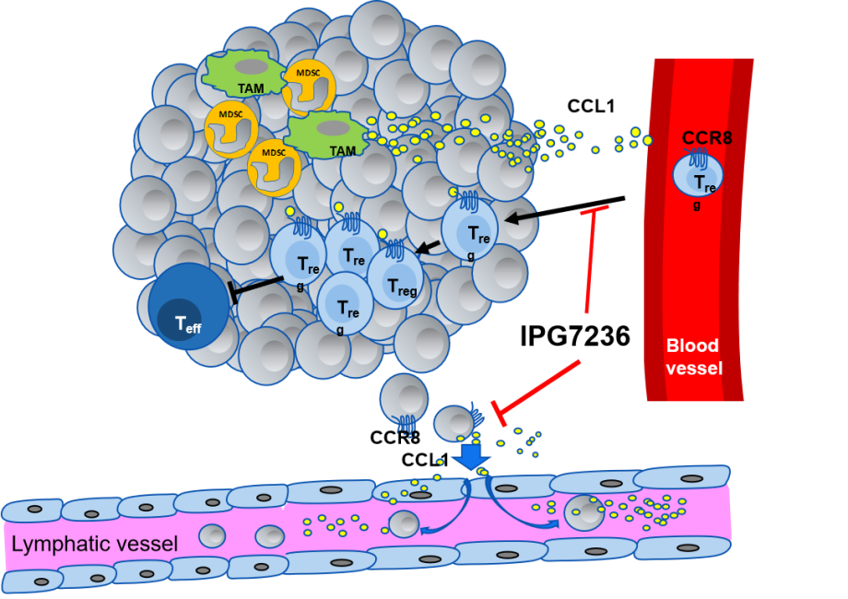
■ CCR8 is predominantly and selectively expressed on tumor-infiltrating regulatory T cells (Tregs), which are the primary drivers of immunosuppression within the tumor microenvironment (TME). These Tregs actively suppress the body’s natural antitumor immune response by inhibiting effector T cell function.
■ IPG7236 works by potently and selectively blocking the CCL1-CCR8 signaling axis, which disrupts the recruitment and retention of these immunosuppressive Tregs at the tumor site. This action breaks down the immunosuppressive shield, enhances the infiltration and cytotoxic activity of tumor-killing CD8⁺ T cells, and enables the immune system to effectively recognize and eliminate cancer cells.
Key Differentiation
■Oral Small-Molecule Advantage: As an oral small molecule, IPG7236 offers practical advantages over injectable biologics, including the potential for lower manufacturing cost, easier distribution, and superior administration convenience.
■ Signaling Blockade vs. Cell Depletion: Whereas ADCC-enhanced antibody approaches deplete CCR8-expressing cells, including peripheral Tregs, IPG7236 blocks CCR8 signaling without inducing cell depletion. This mechanism is designed to reduce the risk of on-target, off-tumor toxicity.
■ Exceptional Safety Profile: In the completed oncology Phase 1 trial, IPG7236 was escalated to 1000 mg BID without DLT or serious adverse events observed.
■ Preclinical Synergy with PD-1 Inhibitors: In preclinical models, IPG7236 showed a statistically significant synergistic effect with an anti-PD-1 antibody, supporting its evaluation as a combination partner with checkpoint inhibitor therapies.
Current Development & Status
■ Phase 1 MRCT (Monotherapy): A multi-center clinical trial for advanced solid tumors has been completed in both the U.S. and China.
■ Phase 1/2 (PD-1 Combination): A Phase 1/2 trial of IPG7236 in combination with an anti-PD-1 antibody is ongoing in patients with advanced solid tumors.
Preclinical In vivo Efficacy
In comprehensive preclinical studies, IPG7236 has demonstrated robust, dose-dependent antitumor efficacy across multiple humanized solid tumor models:
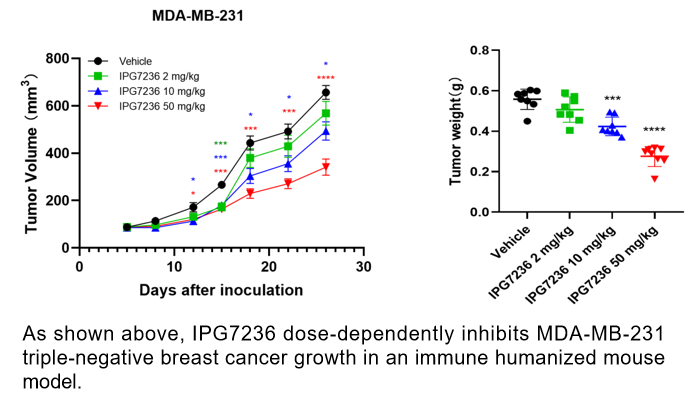
■ Tumor Microenvironment Modulation: In a humanized MDA-MB-231 triple-negative breast cancer model, IPG7236 treatment caused a significant, dose-dependent reduction in tumor-infiltrating Tregs and a corresponding dose-dependent increase in tumor-killing CD8⁺ T cells.
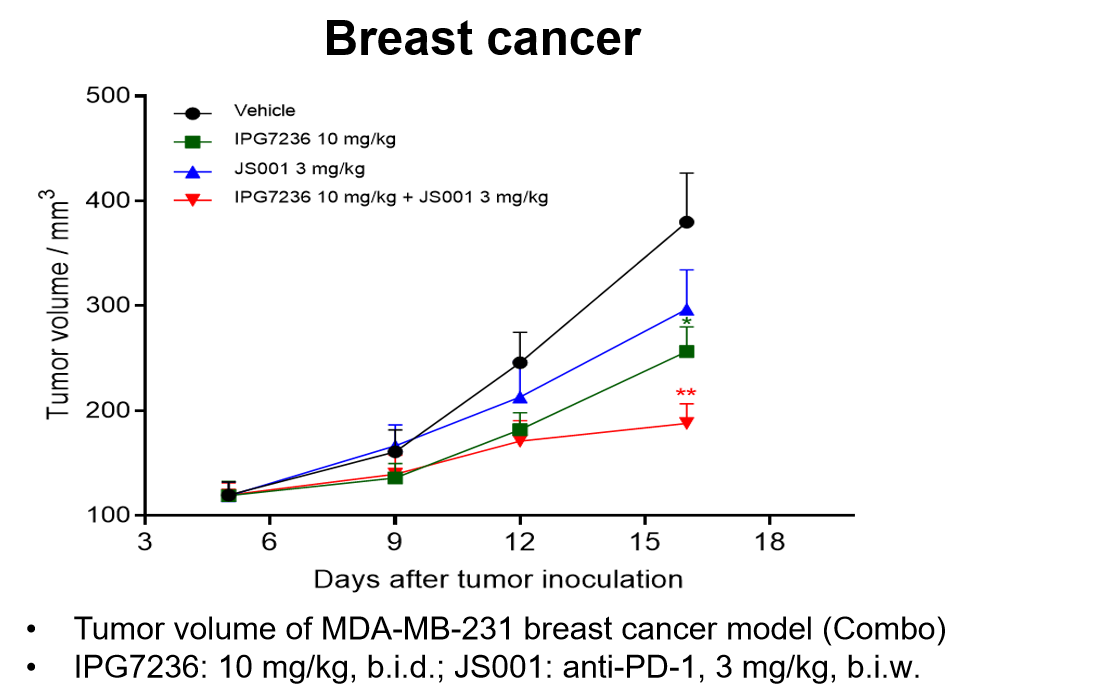
■ Single-Agent Activity: IPG7236 monotherapy (10 mg/kg BID) demonstrated significant tumor growth inhibition (TGI = 47.2%, P < 0.05), while anti-PD-1 antibody (JS001) monotherapy showed lower activity (TGI = 31.6%) that did not reach statistical significance in this model.
■ Synergistic Combination Efficacy: The combination of IPG7236 and JS001 achieved superior antitumor efficacy (TGI = 73.8%, P < 0.01), exceeding the effect predicted by an additive model and either monotherapy alone, consistent with synergy between CCR8 blockade and PD-1 inhibition.
■ Mechanistic Conclusion: This synergistic effect arises from complementary mechanisms of action: IPG7236 reduces CCR8⁺ Treg-mediated immunosuppression and enhances CD8⁺ T cell infiltration, while JS001 prevents T cell exhaustion via PD-1/PD-L1 blockade. These data support the clinical development of IPG7236 in combination with PD-1/PD-L1 inhibitors for solid tumors.
Publications
•Wu Y, Xi J, Li Y, Li Z, Zhang Y, Wang J, Fan GH. Discovery of a Potent and Selective CCR8 Small Molecular Antagonist IPG7236 for the Treatment of Cancer. J Med Chem. 2023 Apr 13;66(7):4548-4564. doi: 10.1021/acs.jmedchem.3c00030. Epub 2023 Mar 29. PMID: 36988587.
Cpyright © 2025 Nanjing Immunophage Biomedical Co.,Ltd
All Rights Reserved. 苏ICP备2022026466号-1  苏公网安备 32011202000830号







 Back
Back